
“ . . . But this number [the number of people killed in the Holocaust], like all the others, must be seen not as 5.7 million, which is an abstraction few of us can grasp, but as 5.7 million times one. This does not mean some generic image of a Jew passing through some abstract notion of death 5.7 million times. It means countless individuals who nevertheless have to be counted, in the middle of life . . . ” — Timothy Snyder, Bloodlands: Europe Between Hitler and Stalin
Memory is a fickle thing, and exasperatingly so. Ray Bradbury accurately shows this in Fahrenheit 451 when describing a child Guy Montag frustrated and in tears at being unable to make a sieve hold sand, no matter how much he tries. But frustration can become fear when one considers how entirely societies and states can forget, and how fast they do.
In Secular Cycles, Peter Turchin and Sergey Nefedov discuss how periods of peace and instability alternate in Western pre-industrial societies based on demographic factors. They observe that during periods of societal instability, internal warfare occurs at intervals of roughly fifty years, an effect they term “fathers-and-sons” dynamics. In essence, the fathers’ generation, which grew up in the midst of war, avoids waging it. Their sons, oblivious to armed conflict and its effects, are prone to engage in it. Given the current state of the world, I cannot help but wonder, amid our disintegrating Long Peace, whether war is so foreign to the Western world that we have forgotten its horrors, just like our ancestors did.
Memory can be stored on drives, books, films, and multiple other media, but it is useless if people don’t seek it out. And sometimes to remember we need to feel the past, as much as it’s possible to do so. This is why historical anti-war media fascinates me. It wants us to experience, through representations, what no one should deserve to experience, yet they have.
Let us then share the memory of two wars which occurred centuries apart across Spain, and whose cruelty led to three of the most vivid and visceral anti-war paintings ever produced.
The first of these paintings was conceived from the ashes of the bloody Peninsular War, Napoleon’s invasion and subsequent struggle for control of the Iberian Peninsula between 1808 and 1813. The French Emperor’s initial goal was to take control of Portugal, which kept trading with Britain despite French efforts to establish a continent-wide blockade of the British Isles. However, Spanish discontent regarding the presence of French troops in their territory led to a revolt across the country in early May 1808. The royal family fled to France, where Napoleon forced them to abdicate in favor of his brother Joseph.
The intervention of the British forces, along with the dogged resistance of the Spanish guerrillas and Napoleon’s botched expedition into Russia, led to the restoration of the Bourbon Monarchy at the end of 1813. In 1814, as part of the celebrations for the return of King Ferdinand VII to Madrid, the Regency Council tasked Fernando de Goya with the production of two paintings in remembrance of the war. Because the arrival of the King coincided with the anniversary of the 1808 May revolt, the painter depicted this uprising and the subsequent French reprisal in two twin canvases: The 2nd of May 1808 in Madrid and The 3rd of May.

It was the latter painting, also called Los Fusilamientos, that would become a cornerstone of anti-war media. In it, Goya shows the executions carried out by the French army the day after the revolt in Madrid. To the right, in somber colors, we observe a group of French soldiers with their rifles and bayonets fixed, aiming at the victims. From the viewer’s perspective, the executioners’ faces are hidden and their individuality is barely notable. They are poised as a single instrument of war. To the right, we see a group of men bunched together, hopeless, cowering in fear. Some dead bodies lie towards the front of the canvas, while a line of those to be killed next trails towards the back. To our left and behind the victims rises a steep hill, trapping them. There’s nowhere to go.
This painting doesn’t glorify conflict, doesn’t try to show a heroic sacrifice or the death of a notable person. At the very center, we see a man with outstretched arms, a white shirt, and stigmata on his hands. The analogy to Christ is evident, almost automatic: an innocent, with a human expression of fear, to be slaughtered pointlessly by an impersonal war machine. Goya wanted to convey the horrors of war as they were, which is why the piece had such an impact on future works.
War between nations is a catastrophe, but that between brothers and sisters might be even more so. Between 1936 and 1939, the world witnessed Spain ripping itself apart during its civil war. While he would claim he foresaw the beginning of hostilities in a dream, Salvador Dali’s opinion that a war was imminent in early 1936 was a foregone conclusion from the polarized state of his country at the time. He would crystallize the anxieties of the imminent conflict in Soft Construction with Boiled Beans (Premonition of Civil War).
#/media/File:SalvadorDali-SoftConstructionWithBeans.jpg)
The surrealist author presents us with a grotesque construction: a giant humanoid, whose face is inspired by Goya’s depiction of Saturn in his black paintings, grimaces while it tears itself apart. An alternative interpretation is that of two different sets of limbs, one male and one female, destroying each other. Between them lies an open space depicting a Spanish landscape. The excrement and dispersed beans seen in the bottom of the canvas have no clear interpretation. That being said, Dali mentioned that it was inconceivable to eat such an amount of meat within the painting without any vegetable complement. In light of an earlier comment after fleeing a worker uprising in Catalonia in 1934—“I sensed the impending great cannibalism and civil war of our history”—and the accompanying excrement in the piece, the idea of a country tearing and eating itself is easy to conceive.
.jpg)
The conflict would be the playground not only of foreign powers, supporting both the Republican Government and Nationalist Insurrectionists, but also of the new ways to conduct warfare. A gruesome episode of this was the bombing of the Basque town of Guernica by the German Luftwaffe on April 26, 1937. At the time, Picasso had been commissioned by the Republican Government to produce a painting for the Spanish Pavilion of the 1937 World Expo in Paris. The news of the horrific bombing, which killed more than a hundred civilians, reached the author in Paris and moved him to make the piece about the event. Thus, Guernica, one of the most influential paintings of the twentieth century, was born.
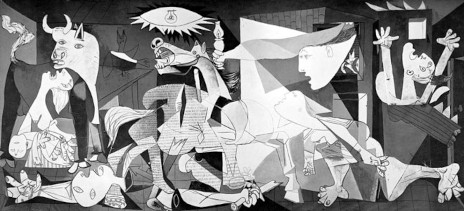
Picasso famously refused to explain the symbolism of each part of the canvas, instead prompting the viewer to be its interpreter. The painting is rendered exclusively in black and white, perhaps to mimic the color of the photographs and news reels of the time, perhaps to evoke the bleak atmosphere—laden with death and despair—of the bombing’s aftermath. A soldier lies dead on the floor. One of his hands is open, and, similar to the martyr in Goya’s painting, its palm displays stigmata. His other hand doggedly holds a broken sword and lies next to a small flower. This element, along with the wounded horse in the center of the canvas, has been linked to the Spanish people, both their suffering (the sword and horse) and their hope of a new Spain rising from the ashes (the flower). To the left of the horse is a terrified chicken, which can be interpreted as the suffering of the animals during the bombing, given that it took place on a market day. An alternative reading is that it is a dove, and as such represents the disruption of peace.
The trio of women in the piece contributes to the feeling of dread and terror: one drowned in grief while holding a dead infant, one consumed by flames, and one holding a candle as she looks at the scene of destruction. A light at the top of the canvas has been associated both with the search for truth and hope and with the falling bombs. Finally, the bull could be either an additional symbol of the Spanish people or of the unrelenting cruelty of the Nationalist faction, which the Germans supported in the war. Regardless of the specifics, the composition as a whole presents a strong anti-war message similar to Goya’s paintings: there’s no glorification of armed conflict or of heroes within it, only a grim showcase of the death and misery brought by war. Because of this, this heart-wrenching piece has been a vivid symbol of anti-war movements from its conception until now.
In Ages of Discord, his follow-up book to Secular Cycles, Turchin analyses societal instability in an industrial society, the United States, and draws parallels between pre-Civil War America and our current age. His final words resonate in my head from time to time: “Will we be capable of taking collective action to avoid the worst of the impending demographic-structural crisis? I hope so. More, I hope that the theory and data explained in this book will contribute to finding solutions that will help us find a non-violent escape from the crisis.”
Whether or not Turchin is right is not important. What is important is that in this day and age—where we have innumerable tales of the horrors of war, where we can easily feel them ourselves via the work of Goya, Dalí, Picasso, and many others—it is a personal and proactive decision not to see and not to remember. I believe we can keep some of the sand in the sieve—maybe not all of it, but just enough to ensure that cooler heads prevail, and that our legacy is not filled with martyrs, their palms laden with stigmata, lying dead on the ground of a sandless beach.