
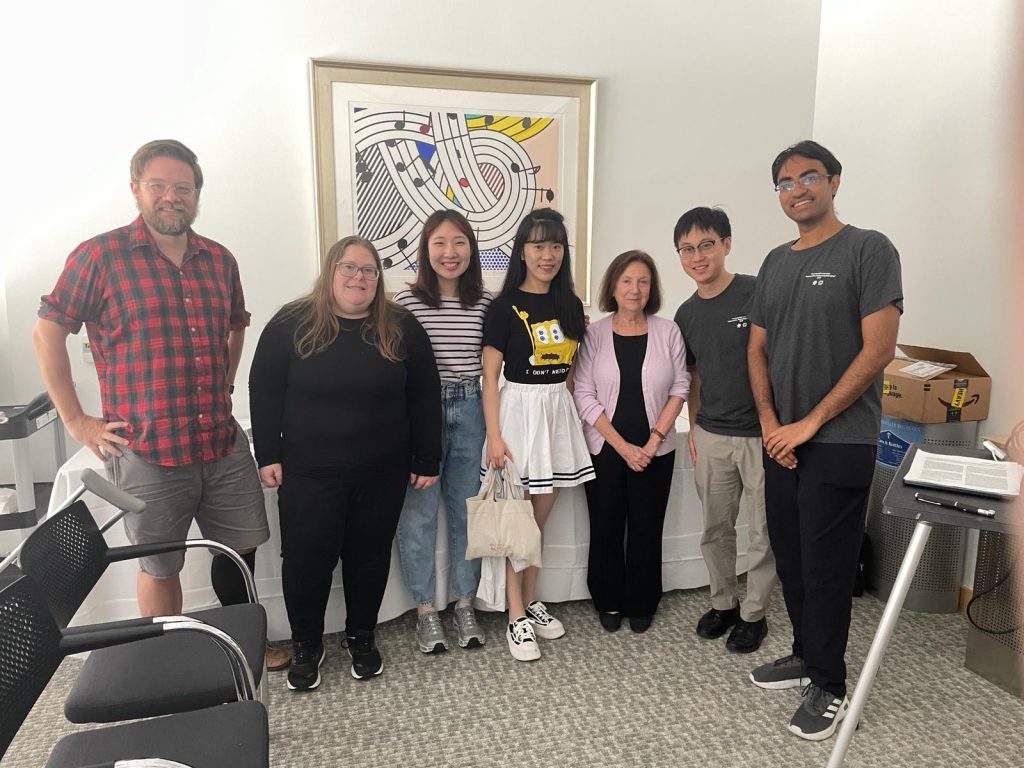
In recent years, Svetlana Mojsov has been the most frequently mentioned name in Rockefeller-related news. During her introductory talk at the Historical Reading of Great Discoveries (HRGD) journal club lunch, Dr. Mojsov walked through key data from her landmark papers (Mojsov et al., J Biol Chem. 1986; Mojsov et al., J Clin Invest. 1987) detailing the discovery of GLP-1 as the incretin. We had the privilege of speaking with Dr. Mojsov in two settings: an interactive interview at the lunch event and an in-depth private conversation in preparation for her presentation. Following is the summary of a few key takeaways. –Charles Xu
Q: Why did you come to Rockefeller for graduate school? How did your training with Bruce Merrifield impact how you approach science?
A: After completing my undergraduate studies, a faculty member at the University of Belgrade recommended the institution. I applied and was accepted. Dr. Merrifield influenced me in many ways. He demonstrated remarkable resilience, enduring years of skepticism and resistance from the scientific community after introducing solid-phase peptide synthesis in the early 1960s. He was also highly focused, kept track of everything happening in the lab, and resisted numerous temptations that could have spread his attention too thin.
Q: You studied glucagon for your Ph.D. and started the pursuit of incretin afterwards. What was the landscape of diabetes research and why was there an urge to explore players other than insulin?
A: I developed an efficient strategy to obtain glucagon by the solid phase method, aiming to develop a competitive inhibitor that could be used together with insulin as treatment for diabetes. Insulin was the only available treatment for diabetes. But insulin was derived from animal pancreases, and it was clear in the 1970s that supplies would not be adequate. Moreover, too much insulin can cause life-threatening conditions of hypoglycemia. A more effective approach would be to stimulate endogenous insulin production only when blood glucose levels are elevated. Incretin—the hypothesized gut-derived hormone that promotes insulin secretion in response to food intake—is well-suited for achieving this targeted therapeutic effect.
Q: Why was it difficult to identify incretin? What were the key inspirations leading to your discovery of GLP-1(7-37) as the incretin?
A: Isolating low-abundance proteins from intestinal lysates posed a significant challenge because the analytical methods, like mass spectrometry for protein sequencing, were still in their infancy and offered limited capabilities in the early 1980s. Later work from Brian Chait at Rockefeller had significantly advanced mass spectrometry techniques and helped shape proteomics into what it is today. The sequencing of the human preproglucagon gene by Graeme Bell and colleagues in 1983 was instrumental. They reported that the gene encodes not only glucagon, but also two related peptides, which they named glucagon-like peptides GLP-1 and GLP-2. These three peptides are flanked by typical cleavage sites involved in the post-translational processing of prohormones. Bell’s paper suggested that GLP-1 and GLP-2 might be new biologically active peptides.
Q: Before your work was published, had anyone else investigated the function of GLP-1? And how did you realize there was a hidden cleavage site and predict peptide 7-37 to be the biologically active form of GLP-1?
A: Indeed, early studies found no biological activity of full-length GLP-1. The publication of these findings led researchers to question why GLP-1 was considered “glucagon-like” at all. When I was examining peptide sequences in preproglucagon, it struck me that the GLP-1 peptide sequence would be very similar to glucagon if it began with the histidine at position 7. Based on my understanding of glucagon’s biochemical properties, I knew that the histidine at the N-terminus is essential for the hormone’s activity. Therefore, I predicted that the single arginine at position 6 serves as a noncanonical cleavage site in the GLP-1 prohormone, enabling the release of its active form, GLP-1(7-37).
Q: What elements of your scientific approach or reasoning do you think were the most important in leading you to the discovery?
A: My Ph.D. and postdoctoral studies with glucagon set the stage for my discovery of the biologically active sequence of GLP-1. I could recall the glucagon sequences forward and backward, and I knew which amino acids in the glucagon sequence were critical for its biological activity. Identical amino acids are present in the same positions in the sequence of GLP-1(7-37). That was the rationale for my hypothesis that GLP-1(7-37) is the biologically active sequence. Obtaining GLP-1 peptides and GLP-1(7-37) by the solid phase method was also critical. It allowed me to quickly synthesize them and to obtain large amounts of GLP-1(7-37). I had an unlimited supply of GLP-1(7-37) and used it to raise specific antibodies and develop radioimmunoassays and chromatographic methods that allowed me to detect GLP-1(7-37) in the intestine. And I then used GLP-1(7-37) in follow-up experiments in the perfused rat pancreas animal model and clinical studies.
Q: I find it remarkable how a deep familiarity with your research subject fostered scientific intuition. Could you elaborate a bit more on the experimental system of pancreatic perfusion in the second paper? I thought it would be easier if we could test GLP-1(7-37) activity in an insulin-producing pancreatic cell line.
A: The pancreatic perfusion system, which requires a delicate surgical procedure, is an animal model that most closely replicates physiological conditions. It was known that many peptides stimulate insulin release in cell lines at very high and non-physiological concentrations. The choice of perfused rat pancreas system was thus essential for the validation of GLP-1(7-37)’s insulinotropic activity. As you can see in Figure 1 [of Mojsov et al., J Clin Invest. 1987], GLP-1(7-37) stimulated insulin release when perfused at concentrations of 50 picomolar, which is the physiological level in the bloodstream. In contrast, GLP-1(1-37) failed to trigger any insulin release when perfused at concentrations up to 500 nanomolar. The experiment demonstrated the physiological effects of GLP-1(7-37) on insulin release. Later that year, Daniel Drucker from the Habener lab published results testing the GLP-1(7-37) I synthesized in a pancreatic cell line, exactly as you mentioned. The effect was modest, even when GLP-1(7-37) was applied at a dose 50,000 times higher than the physiological concentration we tested in the perfused rat pancreas. Therefore, the evidence for insulinotropic effects in the cell line was not compelling.
Q: Identification of incretin seemed like a big deal. What was the publication process like? Did you pitch your work to high-profile journals such as Nature and Science? Have your mentor and your colleagues ever judged your success by where your paper ends up published?
A: The quality of the work, which was my primary focus, should be more important than where it appears. I felt the work was fairly complete and extensive, but I didn’t think it was suitable for publication in Nature or Science, where articles typically had limited space at the time. I was very pleased with the publication process. The editors recognized the significance of our work, and the manuscripts were accepted promptly, with minimal revisions.
Q: After publishing these landmark studies, you came back to Rockefeller, spending most of your career as a research associate professor in Ralph Steinman’s lab. Have you thought about running a typical academic lab?
A: I relocated to New York as my spouse Michel Nussenzweig finished his residency training in Boston and got a faculty position at Rockefeller. At first, I saw it as a temporary arrangement and planned to pursue an independent position later on. I had hoped to lead a small team of my own, since I enjoy working with people, especially mentoring trainees. But soon I realized that the Steinman lab was the best place to continue my studies with GLP-1. It operated like a department where I had independence. I was able to continue my collaborative work on clinical studies demonstrating the efficacy of GLP-1(7-37) in patients with type 2 diabetes. Dr. Steinman was one of the very few scientists in the 1990s who recognized that GLP-1(7-37) would become a new treatment for diabetes. He would discuss with me the progress of the experiments and read my grant applications. He supported me at every step.
Q: Your work was distinct from Dr. Steinman’s research. His generous support reminds me of how Thomas Morgan backed George Beadle—sending him to France to learn how to work with the bread mold, using a grant Morgan invented out of his own pocket. Their remarkable mentorship was evident in their sharp ability to identify important questions, and in how far they would go to support their trainees in pursuing them.
A: I love the story you shared about Morgan and Beadle. It also reminded me of the generosity of Dr. Merrifield. For the syntheses of the GLP-1 peptides at the Endocrine Unit at the Massachusetts General Hospital in Boston, I decided to use a manual shaker that was not available commercially. I called Dr. Merrifield and asked him if he could send me one from his laboratory. Within a few days, it arrived in the mail.
Q: He could have competed with you, but he did not. Was it the general culture? Why do we not hear such stories often nowadays?
A: I was fortunate to have supportive mentors. Although I cannot comment on the general culture, it was not too difficult for me to get funded. I’m concerned that when funding becomes overly competitive, it can create a scarcity mindset rather than one of generosity.
Q: Although originally proposed as a therapy for diabetes, GLP-1(7-37) turned out to be a drug that revolutionized the treatment of obesity. Was that totally unexpected?
A: In the beginning, we didn’t consider GLP-1(7-37) hormonal intervention a viable strategy for treating obesity. It wasn’t recognized that obesity was hormonally regulated until Jeffrey Friedman’s discovery of leptin in the early 1990s. But as the clinical trials of GLP-1(7-37)-based drugs were carried out, its effects on satiety and weight loss became apparent. With my Rockefeller colleague Yang Wei, we showed that GLP-1 receptors are expressed not only in the pancreas, but also in the brain, heart, and kidneys. These results indicated that GLP-1 coordinates biological functions across several other organs.
Q: I also want to ask about the reception of your work. Your pivotal contributions were not acknowledged in the beginning. What inspired you to speak up?
A: This was bigger than whether my contribution was recognized. It is a question of how we disseminate knowledge. Progress in science should build on the foundation of solid evidence. When certain awards did not include my name, what bothered me was that my papers were not quoted. Instead, manuscripts that did not show GLP-1(7-37) as an incretin or that presented inconclusive data were cited. My classmates also shared these concerns and urged me to speak up.
Q: Do you think you were treated unfairly because you are a woman?
A: We weren’t taught to think in terms of gender differences in Yugoslavia, where I grew up. I never attributed any setbacks to my gender.
Q: I guess not being part of the traditional academic circles has likely put you at a disadvantage. I’m glad those barriers are finally broken, and your work is now receiving the recognition it deserves. Your experience is what we want to highlight with our journal club. It should be the data that matters the most, and history will be the better judge. Being prosperous in academia and being a good scientist are not always the same goal and might take different skill sets and mentalities. Would you share some advice for young people whose primary ambition is to be a good scientist?
A: The most important lesson I learned from my mentor Bruce Merrifield and working with Ralph Steinman was to have integrity and be honest.
Q: Thank you! May time be fair to those who are honest.
A: Thank you for the opportunity to speak.
We acknowledge Kimberly Elicker for assisting the interview.