
“I don’t know how to describe my work, because it’s not always the same thing. It’s like asking somebody, asking Miles [Davis], “How does your horn sound?” I don’t think he could really tell you why he plays this at this point in the music. You’re sort of on automatic.” – Jean-Michel Basquiat
It’s hard for a piece of art to disturb me, and even harder for me to explain why it does. But some art perturbs your very soul, producing a feeling that rationality cannot dispel. For me, this was Everywhere at the End of Time by the Caretaker, a fantastic take on how dementia destroys the mind and how a person lives through it as their memories mangle and degenerate into nothingness. That’s what disturbs me most: you know what’s coming, and you know you can’t do anything about it. At some point you stop caring—because your brain forgot how to care—and just embrace the ride towards death. Sometimes I wonder: was this what Basquiat was feeling when he painted Riding with Death?
Jean-Michel Basquiat, like many children of immigrants, was a crucible of cultures. He was born in Brooklyn in 1960, but his story doesn’t begin there. Part of it begins in Port-au-Prince, where his father Gérard was born before he fled to the U.S. in 1955 due to political turmoil. It also begins in Puerto Rico, where the parents of his mother Matilde were born. Further, it begins in millennial African cultural traditions, some of which he saw in historical artifacts during trips to museums and galleries with his mother, some of which were co-opted by European art at the onset of the twentieth century. Yet another part of it begins at the death-laden streets of Guernica, whose depiction by Picasso was one of Basquiat’s earliest artistic influences.
His mother’s love of art and fashion and his father’s love for jazz would leave a strong mark on the young Basquiat. A further influence unexpectedly manifested because of a car accident. In 1969, he was hit by an automobile when playing in the street, leading to a one-month hospitalization. To pass the time, his mother bought him a copy of Gray’s Anatomy, from which he derived a fascination for the human body.
Basquiat’s late childhood and adolescence were turbulent. After his parents divorced and his mother was institutionalized for mental health reasons, he lived with his father and his two siblings until he was seventeen years old. A school dropout, Basquiat started down his road to fame with SAMO (standing for either “same old” or “same old shit”), a project he initiated with his high school friend Al Diaz during the late 1970s. In Diaz’s words: “We began to spread our satirical message of SAMO through graffiti; it would very quickly develop into a vehicle for voicing opinions on the world around us as we observed it. We were creating an entirely new style of graffiti. It was literate and message-based.” With texts like “SAMO©,,, AS AN END TO THE 9 TO 5 “I WENT TO COLLEGE” “NOT 2-NITE HONEY”,,,BLUZ’,,,THINK,,,”, “SAMO© AS AN ALTERNATIVE TO GOD”, or “SAMO© DOES NOT CAUSE CANCER IN LABORATORY ANIMALS”, the duo tried to convey a message, as opposed to just presenting a graffiti tag. “We were commenting on whatever we were dissatisfied with, or thought was funny—whatever! Consumerism, religion, politics. This was all from the mind of someone who was seventeen and nineteen years old—we were very young minds,” said Diaz in a different interview. Albeit only a yearlong project, this idea of words having a powerful meaning would strongly influence all of Basquiat’s later work.
The 1980s were Basquiat’s time to rise and to fall. He started the decade homeless, peddling t-shirts and postcards and sleeping where he could. However, through his frequenting of Club 57 and Mudd Club, two lower Manhattan nightclubs attended by a new generation of artists and musicians (notably Keith Haring), he was able to promote his art and eventually enter the city’s artistic scene. Basquiat had his first group exhibition in 1980 at the Times Square Show and his first solo in 1982 at the Annina Nosei Gallery. Untitled (1981) stands out from this latter exhibit. The piece shows a carefully drawn skull with a downcast, depressed look. It is made up of multiple parts sewed together, hinting at recent damage or trauma, and stands in front of a background resembling the New York subway. In a way, it shows the many faces and struggles that coexisted inside Basquiat during these turbulent years early in the decade.
One of those struggles, one Basquiat would concern himself greatly with, was the issue of African American representation in art. In his own words: “I think there’s a lot of people that are neglected in art. I don’t know if it’s because of who made the paintings or what, but black people are never really portrayed realistically in—not even portrayed in—modern art enough, and I’m glad that I do that. I use “black” as the protagonist because I am black, and that’s why I use it as the main character in all the paintings.” His 1983 piece Hollywood Africans (on display at the Whitney Museum here in New York) depicts Basquiat, along with graffiti artist Toxic and musician Ramellzee, in a style which has been linked to Roman depictions of Emperor Augustus. This power display, along with background texts that can be associated with the film industry and African American roles in it, calls attention to the lack of representation of Black artists in Hollywood. While not present in this painting in particular, Basquiat’s most frequent motifs—the three-pointed crown (seen, for example, in Red Kings) and the West African griot (seen, for example, in Flexible)—can be understood both as a celebration or enthronement of African American art and as a reflection of his own role in a white-dominated art scene.
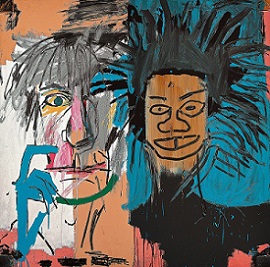
The 1980s also marked the beginning of Basquiat’s close friendship with Andy Warhol, who would act as a friend and father figure to the young artist. Although they had briefly met before, art dealer Bruno Bischofberger formally introduced the two of them in 1982. On the same day, Basquiat produced Dos Cabezas, a painting of a polaroid picture Warhol had taken of the two of them, and gifted it to Warhol. The two worked together and inspired each other for a few years, up until their joint exhibition, Paintings, shown at the Tony Shafrazi Gallery in New York in 1985. The exhibition and their friendship were strongly criticized by the media, which claimed that Warhol was using Basquiat to gain relevance and, in the process, hindering the latter’s development as an artist. This eventually led to their separation. Among their many collaborations, Basquiat and Warhol both cited the piece Ten Punching Bags (Last Supper) as a personal favorite, made up of a series of ten punching bags decorated with drawings of Jesus Christ and multiple uses of the word “Judge,” which Basquiat complemented with his personal motifs.

Warhol’s sudden death in 1987 would ultimately lead to Basquiat’s own. Although they had grown apart since 1985, Basquiat’s devastation over Warhol’s death compounded the drug abuse problems he had been having for a few years. He ultimately died of an overdose in August 1988. One of his last paintings, the aforementioned Riding with Death, shows a black figure in a style reminiscent of cave paintings, being dragged by a white skull, believed to be a metaphor for the repression of and discrimination against African societies and their descendants that greatly affected Basquiat throughout his life. The black figure flails its arms while the skeleton inexorably carries it somewhere. As with Everywhere at the End of Time, I see in this painting the dread of knowing what’s coming and knowing you can’t do anything about it.
Maybe Basquiat felt this all his life. Deep down, Basquiat had always been the same talented child drawer who wanted to be famous. He was eclectic in his influences, a true lover of art, a rebel in both style and subject, and one of the most influential American painters of the twentieth century. His career was a flash in the bigger scheme of things, but one whose radiance glows as strong and relevant as ever in contemporary America.