
Migration is woven into the fabric of the scientific community. Many scientists move across regions or continents to pursue opportunities for training, education, and collaboration. These journeys affect both an individual’s life and the trajectory of scientific innovation, fostering diversity of thought and new discoveries. However, as anti-immigrant sentiment increases in the United States and around the world, many scientists now face additional barriers that threaten this essential flow of knowledge and talent.
 Life as a Regional Migrant Pursuing a Career in Science
Growing up on the U.S.-Mexico border in El Paso, TX meant that migration—a staple of the city’s vibrant Mexican culture—was second nature to me. Like many cities distant from major research hubs, El Paso offered limited scientific opportunities; therefore, I ultimately moved across the country to New York City. Adjusting to a more rigorous and competitive research environment was challenging, and life beyond the bench brought its own hurdles. Despite having lived in the United States my whole life, adapting to the East Coast’s social and cultural norms while maintaining close ties with family and friends back home proved difficult.
Dr. Yazmin Carrasco, Assistant Dean of Access, Belonging, and Student Success at Weill Cornell, had similar experiences throughout her scientific career. Like me, she grew up in the Paso Del Norte region, but on the other side of the bridge, in Ciudad Juárez. While attending The University of Texas at El Paso (UTEP), Dr. Carrasco’s commute required crossing an international checkpoint—a daily occurrence for many residents of this region. One of her first cultural hurdles was the language barrier. “The first semester of college, [it] was hard to switch to 100% English,” she recalled. Fortunately, the large Hispanic population at UTEP allowed her to find community in an unfamiliar social space.
Dr. Carrasco’s transition to UT Southwestern for graduate school sparked a different kind of challenge. She faced social and professional barriers exacerbated by the lack of diversity among her peers and advisors. Professors commented on her English and writing, at one point telling her she should “go back to elementary school to figure out sentence structure.” “I became a chameleon, trying to fit in by shifting parts of my personality,” she explained. Faculty members doubted her ability to graduate, but Dr. Carrasco turned their condescension into motivation to persevere and excel in her career.
Our stories overlap with common themes of adaptation and resilience, yet underscore the privileges we were afforded as U.S. citizens. Dr. Carrasco and I could move freely within the country and work without fear of visa restrictions. For many international scientists, those basic freedoms are not guaranteed. Their journeys are marked not only by cultural and linguistic adjustments but also by the heavy weight of shifting immigration laws, financial burdens, and constant uncertainty about their future in the countries where they contribute so much.
Scientists Face Additional Burdens Coming to The United States
Across the United States, foreign-born researchers often face legal, financial, and discriminatory barriers that can negatively impact their career. A 2024 survey commissioned by the U.S. National Academies’ Board on International Scientific Organizations reported that 40% of surveyed international scientists experienced visa issues that prevented them from participating in professional activities in the U.S. The negative impact of the United States’ current visa process has also trickled down to international collaborative opportunities: the same report found that 27% of respondents have stopped or avoided collaborating with U.S. scientists due to visa challenges.
In addition to dealing with bureaucratic complications, non-U.S. citizen scientists often find that the funding sources available to them are limited. One of the largest pools of funding for scientific research in the United States has historically come from the federal government. However, there are often eligibility restrictions against non-citizens. Recent changes in federal funding are also affecting international collaborations. The NIH has announced that foreign subawards for international collaborations will not be issued moving forward until there are changes in the grant subaward structure.
Despite these challenges, it is undeniable that migrant workers are the backbone of STEM occupations in the United States. Recent reports indicate that immigrants comprise up to 26% of the total STEM workforce and 43% of scientists and engineers with a doctorate. Additionally, 73% of international students who obtained a Ph.D. in science and engineering fields between 2017 and 2019 stayed in the United States for 4–6 years after degree completion. Our own Tri-Institutional community is a blend of international and regional migrants: over half of respondents surveyed for this article reported that they relocated from abroad or outside of the Tri-State area for their current position.
The diversity of thought that many international scientists bring to the United States is not a new phenomenon. Half of the 2025 Nobel Prize winners and 40% of American Nobel Prize winners since 2000 in science categories immigrated to the United States. All evidence highlights the necessity of migration for a robust and innovative science community in the United States—in stark contrast to the Trump administration’s anti-immigrant rhetoric.
Changes in U.S. Immigration Policies Could Be the Catalyst for American Brain Drain
President Trump has repeatedly tried to convince Americans that “illegal aliens” are “taking [their] jobs.” These unfounded claims shift the blame for job loss and worsening economic conditions to the broader migrant community. In reality, there are no major industries where immigrants outnumber U.S.-born citizens. The focus should instead be on decades-long state and federal policies that transformed the American economy from a primarily skills and manufacturing market to one centered on technology and services, without sustained efforts to help Americans make the transition as well. Labor sectors with higher proportions of authorized immigrant workers, including science, often require specialized training and skills that are a barrier for many Americans. For example, the average cost of college in the United States is currently over $38,000 per year. Many undergraduate research training grants that helped alleviate this large financial burden, including the NIH-funded Maximizing Access to Research Careers (MARC) program, were recently terminated due to federal cuts.
Earlier this year, the Federation of American Scientists held a bipartisan House Research and Development Caucus Briefing to discuss how current political actions, such as withholding NIH grants and increasing visa restrictions, have been negatively affecting the American scientific community. In addition to increased federal investment in scientific research, the panel noted that there is a need to reform current STEM immigration policies.
“A lack of sustained federal funding, deteriorating research infrastructure and networks, restrictive immigration policies, and waning international collaboration are driving this erosion into a full-scale ‘American Brain Drain.’”
-Congressman Bill Foster (IL) during the July 22, 2025 R&D Caucus Briefing
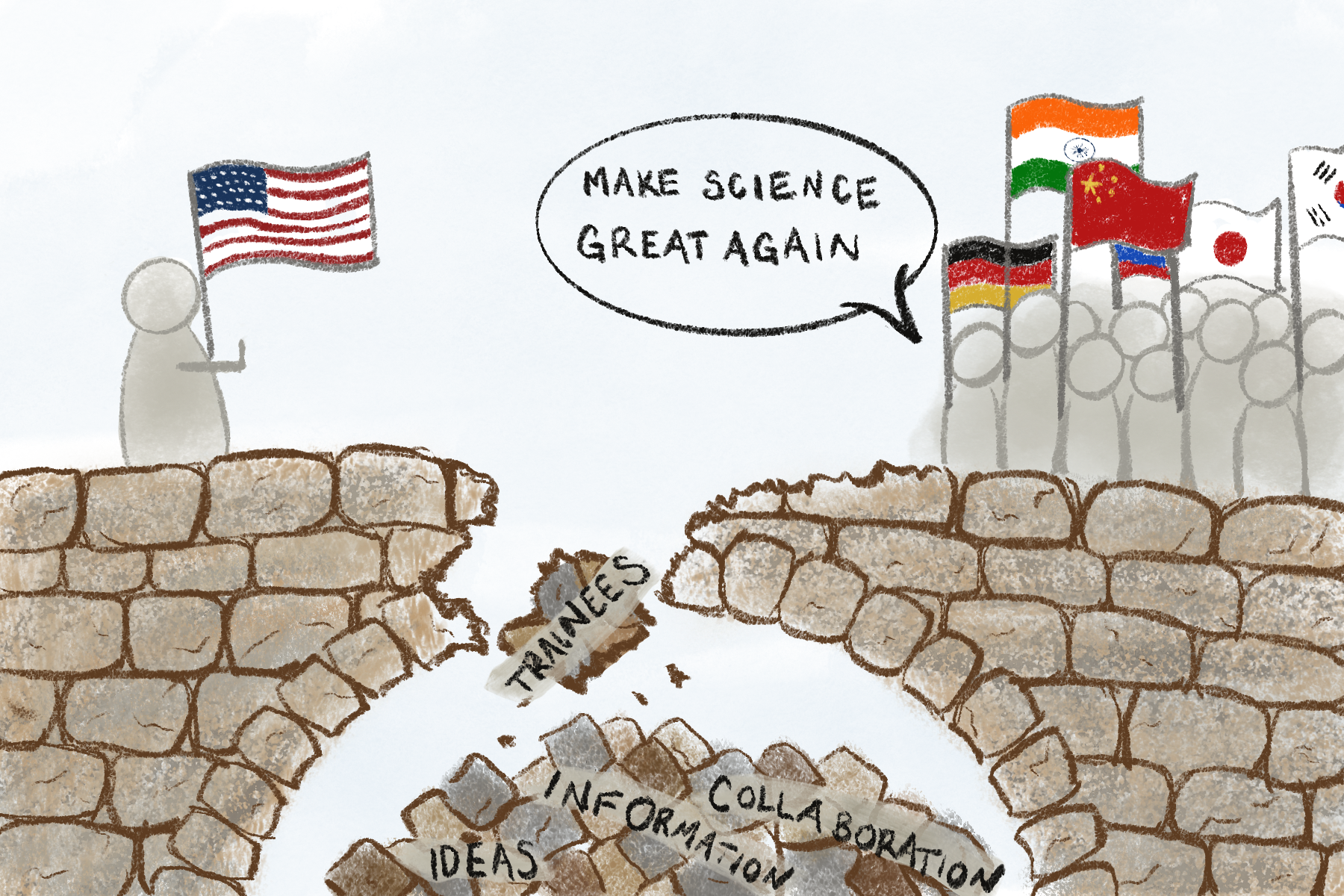
However, recent proposals to change U.S. visa programs for international scientists and scholars might be the final push that topples the United States’ STEM workforce. The H-1B visa program was created under the Immigration Act of 1990 to help temporarily fill employment gaps in highly skilled labor sectors, including technology and medical sciences. Currently, there is an annual cap of 65,000 visas, with an additional 20,000 visas reserved for applicants who graduated with a master’s degree or doctorate from a U.S. institution. In September, the Trump administration announced changes to the H-1B visa program that would add more restrictions for applicants and include a $100,000 fee for new H-1B petitions, to be paid by the applicant’s employer. (For context, the previous fee was $2,000 to $5,000.) The increased fee alone could restrict universities from sponsoring international talent, especially against the backdrop of federal funding cuts. Additionally, the U.S. Department of Homeland Security (DHS) is proposing changing the current lottery system to a weighted selection process where higher wage levels would result in more lottery entries for companies. DHS has also suggested implementing a 4-year maximum timeframe for F and J student visas.
“My significant other, who I live with, is an immigrant, and the current immigration policies, like the changes for H-1B visas, have made our situation stressful.”
-Anonymous Respondent
Anti-immigrant Rhetoric and Aggression are Adding Stress to Many Scientists’ Lives
Increased restrictions on visas have been coupled with DHS becoming more aggressive. Many foreign-born scientists and academics became fearful as reports of scientists being detained made the headlines. Russian-born scientist Kseniia Petrova was detained in February by immigration agents at a Boston airport after a trip to France. After she failed to declare frog embryos that she was using for ongoing research, federal agents took the Harvard scientist into custody, canceled her visa, and transferred her to a Louisiana detention facility.
In addition to the changing legal landscape of international migration, growing anti-foreigner sentiment across the globe has undoubtedly added stress to the lives of many scientists. From ICE raids on predominantly Hispanic cities in the United States to religious restrictions in India’s naturalization policies, anti-immigrant policies often impact other individuals who come from similar racial, ethnic, or religious backgrounds, regardless of their citizenship status.
When I asked Dr. Carrasco whether she has seen changes in students over the past six months, she noted that “there is an increase in anxiety and stress due to immigration policies.” Some students have expressed fear of what these policies and their aggressive enforcement could mean for them as international scholars or having come from similar backgrounds as detainees. Dr. Carrasco’s observations were echoed in our survey of Tri-I scientists: over 90% of respondents reported that recent actions by the U.S. government and federal agents towards migrants have significantly increased stress in their lives. This increased stress is urging many scientists to look for opportunities in other countries. Nearly a third of survey respondents reported that they will more than likely look, or are currently looking, for jobs outside of the United States. They cited the current political climate, changes in funding, and a poor job market as major factors in this decision.
“It is an extra level of stress, that everything can change from one day to the next and setting up your life here but knowing that maybe it will all be taken away. Living with such uncertainty of whether you can establish your life or not remains a low level of constant daily stress.”
-Anonymous Respondent
I met with Yanira Guerra, a fifth-year Ph.D. student at Weill Cornell, to discuss her experience as an internal migrant. Yanira was raised in the DMV (D.C./Maryland/Virginia area) outside of Washington, D.C., a region with many pockets of diverse communities. Like most Americans, she first left home to attend college out of state in search of the best academic opportunities. One of the struggles she remembers during this transition period was adjusting to the homogeneous culture of her small college town. “There are small things that you would be unaware of, like where to get Peruvian food and cultural differences due to the upbringing of peers,” she explained.
“America can’t run without immigrants, regardless of documentation status.”
-Yanira Guerra
When asked how her confidence in the science community has changed since the beginning of this year, Yanira said that she has mixed feelings. “It’s hard to see scientific institutions bend the knee to Trump’s demands.” She noted that on the individual level, she is very proud of the scientists who have stood up and fought for the right to do science. Growing up in the DMV exposed her to many protests and political movements at a young age, but she has become more active in the past year due to changes impacting the immigrant and science communities. “There have always been divisive sentiments [towards immigrants], but this administration has been particularly . . . destructive on the implementation of immigration policies.”
Migration has always been the lifeline of science, driving discovery through the exchange of ideas, cultures, and perspectives. From border cities like El Paso and Ciudad Juárez to global research hubs like New York, scientists move not out of comfort, but often out of necessity and in search of more opportunities.
Science transcends regional and international borders, but scientists increasingly cannot. Each policy that adds more restrictions to visas sows fear and devalues foreign-born labor. These systemic limitations don’t just harm individuals—they erode the collaborative foundation of scientific innovation. Science thrives where curiosity is allowed to move.